
 Brij Khandelwal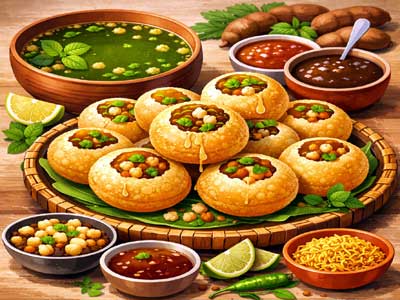
The argument had reached boiling point at a crowded wedding reception stall. "Mine had more tamarind!" "No, yours had extra mint!" "The last puri wasn't even full!"
Meanwhile, the chaat vendor calmly prepared another golgappa, silently watching three generations of the same family wage what looked suspiciously like a border dispute over flavoured water.
Read in Hindi: 'गोल गप्पे' है भारत की सबसे ‘लोकतांत्रिक’ डिश
If there is one place where India's democracy truly works, it is around a chaat cart. Rich or poor, politician or professor, schoolchild or CEO, everyone waits their turn with an open mouth and absolutely no dignity. Chaat has no VIP queue. The vendor decides who gets the next golgappa, and his verdict is final.
Outside a lane near Agra's busy Hospital Road, little has changed in decades. The air still carries the perfume of sizzling oil, roasted cumin, fresh coriander and tangy tamarind. Bulaki, a third-generation chaat seller, barely looks at his hands anymore. His thumb cracks open a crisp puri, fills it with spicy water, mashed potatoes and chickpeas, and sends it flying towards a waiting customer before the order is fully spoken. It is culinary muscle memory, perfected over a lifetime.
Few foods carry so much history in such a tiny bite. Like every great Indian story, chaat comes wrapped in legends. The most popular claims Mughal emperors floated down Chandni Chowk's famous canal on moonlit evenings, nibbling spicy chaat while musicians serenaded them from the banks. It is a delicious story.
Unfortunately, history finds it rather hard to swallow. The canal certainly existed. Shah Jahan's daughter, Jahanara Begum, designed Chandni Chowk around the elegant Faiz Nahar canal, lined with shady trees and reflecting pools that shimmered under the moonlight, giving the market its famous name.
But no Mughal chronicle mentions emperors cruising around with plates of papdi chaat balanced on their laps. Historians suspect the tale gathered a little more spice every time it was retold, much like the chutney itself.
Another story has slightly firmer footing. It says royal physicians worried that Delhi's alkaline water upset digestion, so they advised the emperor to eat tangy snacks flavoured with tamarind, black salt, yoghurt and aromatic spices. Whether or not Shah Jahan actually followed such dietary advice remains uncertain, but anyone who has overeaten at a wedding knows that Indian grandmothers have been prescribing digestive spices for centuries.
The surprising truth is that chaat is far older than the Mughal Empire. Take the humble golgappa. Travel a few hundred kilometres, and it changes its name. In Delhi, it is golgappa, in Mumbai pani puri, in Kolkata puchka, elsewhere phulki or gupchup. It is perhaps India's most travelled passport.
Some trace its origins to the ancient kingdom of Magadha over two thousand years ago. Another charming tale from the Mahabharata credits Draupadi, who supposedly invented it by stuffing leftover dough with whatever she could find to satisfy her famously hungry husbands. Historians cannot prove either story, but both suggest one important fact: chaat has belonged to ordinary Indians for an extraordinarily long time.
Of course, those early golgappas contained no potatoes. The potato arrived only after the Portuguese reached India in the sixteenth century. Earlier fillings were probably lentils, pulses or seasonal vegetables.
History, like chaat, keeps changing its ingredients. The Mughals did not invent chaat. They helped popularise it. While imperial kitchens dazzled guests with kebabs, biryanis and fragrant Persian-inspired dishes, the bustling markets of Delhi, Agra and Mathura remained the kingdom of vegetarian snacks. Chaat was affordable, filling, portable and delicious. Merchants, pilgrims, labourers, priests and noblemen all found themselves reaching for the same crunchy treat.
That is perhaps Chaat's greatest achievement. It flattened social hierarchies long before social media invented hashtags. Delhi perfected papdi chaat and dahi bhalla. Agra proudly embraced its crisp aloo tikki. Mathura added temple flavours shaped by festivals and devotion.
Later came Partition, migration and the railways, carrying recipes across the country. Mumbai created bhel puri and sev puri. Kolkata gave puchka an extra fiery personality. Every city borrowed the same vocabulary of crunch, spice, sweetness and tang, then wrote its own delicious sentence.
Today, chaat is a billion-rupee industry. It appears on silver platters in luxury hotels, stars in glossy Instagram reels and wins gourmet awards. Yet its soul still belongs to the roadside cart.
Bulaki has never worried about culinary history or food trends. He is busy filling another golgappa while two impatient customers argue over who is next. Perhaps that is the real secret of chaat.
Empires have risen and fallen. Kings have vanished. Dynasties have disappeared into history books. But the man behind the chaat cart is still asking the same timeless question: "Teekha ya medium?"
Related Items
Coffee could hold the secret to spotting deadly dyes in food
Indusfood 2025: A global showcase of Indian Food Economy
Green views lead to healthier food choices, says study