
 Brij Khandelwal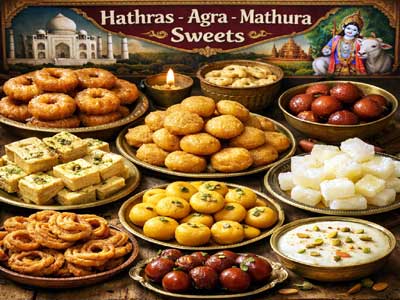
Braj Mandal does not just live; it melts. The sacred triangle of Agra, Mathura, and Hathras hums softly to the music of Krishna’s love. In the breeze along the Yamuna and in the fine dust of Braj, the fragrance of milk, ghee, and khoya still lingers like an old memory that refuses to fade.
Here, sweets are not mere indulgences. They are devotion, ritual, and inheritance rolled into every bite. In temples, offerings rise with the sentiment, “Laal ko meethi kheer bahut bhaave”. Plates of peda, laddoo, rabri, and mohan thaal are not just food; they are expressions of faith. In Vrindavan, a glass of chilled lassi feels like grace itself. In Mathura, a kulhad of thick, simmering milk or a bite of khurchan feels like fulfilment.
हिंदी में पढ़ें : आगरा, हाथरस और मथुरा की मिठासभरी परंपरा
Braj’s sweets carry history on their tongues. There is Mughal richness in their depth and Braj simplicity in their soul. Agra’s famous petha remains the great equaliser: loved by the rich and the humble alike. But beyond it lies a wider universe: ghewar, kalakand, barfi, gulab jamun, balushahi, peda, rabri, and the delicate flakes of soan papdi. These are not just desserts; they are stories shaped in ghee and khoya. While Bengal leans on chhena and the South celebrates coconut, Braj stays loyal to its dairy heart. Even the thick, slow-cooked rabri carries whispers of Mughal kitchens.
The legacy of sweetness finds a living home in Agra’s iconic Bhagat Halwai. Founded in 1795 by Lekh Raj Bhagat in Belanganj, near the Yamuna, it is among India’s oldest surviving sweet shops. For over two centuries, it has guarded recipes like family heirlooms. What began with simple offerings- bedai, jalebi, and laddoo, has grown into a vast spread of sweets, snacks, and confections. Yet, the essence remains unchanged: purity, patience, and tradition. Its makkhan samosa and pista barfi still draw loyal patrons across generations.
Once, the street outside Bhagat Halwai doubled as a political adda. National leaders paused here for breakfast, conversations simmering alongside hot kadahi milk. Today, the shop has expanded into multiple outlets, but its taste remains rooted in the old ways; rich with pure ghee and slow-crafted khoya.
Agra’s lanes still hold quiet rituals. In the afternoons, people gather around large iron woks, sipping thickened milk cooked for hours over a slow flame. It is not just a drink; it is an experience, unhurried and deeply local.
Across the city, old names continue to serve enduring flavours: Heera Lal Misthan, Gopal Das Petha Wale, Devi Ram, Dauji, Gopika, GMB. Each has its loyal following. At mithai shops, the petha and dal motth remain iconic. The rabri here is so dense that a spoon can stand upright; a quiet testament to patience and craft.
In Mathura, the humble peda becomes sacred. Soft, lightly golden, enriched with khoya, ghee, and nuts, it melts effortlessly, leaving behind a gentle sweetness. Shops like Kanha Sweets and Basanti Mithai turn milk into poetry, slowly boiling it into thick rabri laced with pistachio slivers. Then comes makkhan sandesh, butter blended with fruits and nuts, light, creamy, almost playful. And khurchan, scraped patiently from layers of milk cream, offers a sticky, saffron-scented delight that feels both rustic and refined.
Hathras brings its own character to the table. Known for its hing kachori, it also crafts remarkable sweets. Its ghewar arrives rich with dry fruits, while soan papdi breaks into delicate, crisp layers that linger long after. Here, halwais still work over traditional chulhas, letting ghee deepen every flavour. Even the khurchan carries a distinct aroma, earthy, warm, unforgettable.
Beyond the cities, smaller towns keep the tradition alive in quieter ways. Pinahat’s khoya-filled gujiyas mark festivals with crisp sweetness. Kiraoli’s dense, flavour-packed pedas reflect a culture that values depth over display. These places may be small on the map, but they hold Braj’s essence intact.
What sets Braj sweets apart is their honesty. Simple ingredients. Slow processes. No shortcuts. In a world of packaged convenience, these sweets still breathe. They nourish as much as they delight.
Visitors who come to see the Taj Mahal often leave with something more lasting, a taste. Walk through these streets. Pick up a peda, dip it into rabri, and break a piece of soan papdi. And suddenly, the past feels present.
Because in Braj, sweetness is not just tasted. It is remembered.
Related Items
How Agra-Mathura Sweetmeats are fighting for their future
Symphony of 'Sawan' and sweetness of 'Ghevar'
Crunchy Papad Bhel, Teens would just love it…