
 Samiksha Bharti News Service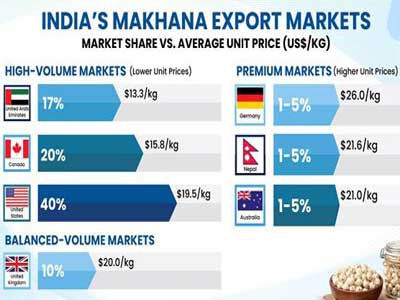
Makhana, or fox nut, has emerged as a fast-growing agri-food product in India. This is due to its nutritional value, rising health awareness, and increasing global demand.
India is the world's largest producer of makhana. Bihar contributes nearly three-fourths of the country's production and around 80–85 per cent of the global supply. Read in Hindi: भारत का मखाना, पारंपरिक फसल से ग्लोबल सुपरफूड तक…
In 2025–26, India exported 7,264.89 MT of makhana products, with an export value of ₹19296.08 lakh. Domestic prices also increased significantly due to strong demand for healthy and premium snacks.
Makhana, scientifically known as Euryale ferox, is an aquatic crop grown mainly in shallow ponds, lakes, and wetlands. The edible part of the plant is its seed. After roasting or processing, the seed is popped and consumed as a fox nut. India is the world’s largest producer of makhana. This position is supported by suitable agro-climatic conditions and long-standing cultivation practices, mainly in Bihar, West Bengal, and Assam.
Over the years, makhana has evolved from a traditional food of Bihar into a widely consumed health food across the country. This transformation has been driven by rising health awareness and supportive government policies. The growth of startups producing value-added makhana products and the increasing role of Farmer-Producer Organisations have also contributed to the sector's expansion.
India continues to be the clear global leader in Makhana production. Bihar accounts for nearly three-fourths of India’s Makhana production and contributes around 80-85 per cent of the global supply. Makhana cultivation is mainly concentrated in North Bihar.
It is especially prominent in the Kosi basin districts of Supaul, Saharsa, and Madhepura, as well as in nearby areas of the Mithila and Seemanchal regions. This makes the state the central hub of the Makhana sector.
In 2024-25, as per the final estimate of the Horticulture Statistics Unit, DA&FW, the total production of makhana in India was 63,910 Metric Tonnes, with an average productivity of 2.03 MT per hectare.
As per the Second Advance Estimates (2025–26), total production of makhana in India is 80,590 MT, with an average productivity of 2.34 MT per hectare. Bihar is the leading producer of makhana in the country, with a production of 60,000 MT in 2025–26 and an average productivity of 2.00 MT per hectare.
Traditionally grown in ponds, modern techniques like field-system farming and improved varieties such as Swarna Vaidehi and Sabour Makhana-1 have helped increase productivity. The growth has been driven by an increase in cultivated area, improved productivity, and reduced cultivation risks.
‘Mithila Makhana’ has been granted a GI tag, recognising the unique quality, reputation, and traditional knowledge associated with makhana produced in the Mithila region of Bihar. The GI status provides legal protection, enhances market differentiation, and strengthens branding potential in domestic and international markets.
India produces more than 0.6 lakh metric tonnes of Makhana each year. About 40 per cent, or nearly 0.23-0.25 lakh metric tonnes, is exported, while the remaining quantity is consumed domestically. With growing global demand for clean-label and plant-based superfoods, India’s strong production base places Makhana as a premium snack in international markets.
The domestic Makhana market recorded annual growth of 17-18 per cent between 2021-22 and 2024-25. This growth has been driven by rising health awareness, premiumization, and the expansion of branded players. Strong domestic demand has also helped shield the sector from fluctuations in export markets.
The market is expected to reach ₹11,000-12,000 crore by 2029-30. Production volumes increased by only 4 to 5 per cent during the period from FY 2022 to 2025. Average prices increased from about ₹500 per kilogram during 2020-2022 to nearly ₹1,250 per kilogram in 2025. This increase is linked to higher demand for health-focused snacks, premium branding, and limited supply response.
India’s monthly domestic consumption of popped Makhana is estimated at 3,000-3,500 metric tonnes. During festive periods, when demand for snacks peaks, consumption rises to around 5,000 metric tonnes.
Within domestic consumption, branded Fast-moving consumer goods and organised snack players account for 1,800-2,000 metric tonnes per month. This is driven by the rapid premiumization of the category and the expansion of retail penetration. Loose and unorganised retail contributes 1,200-1,400 metric tonnes per month, remaining significant in Tier-2 and Tier-3 markets, even as packaged formats gradually gain popularity.
Before 2025, Makhana was classified under general Harmonised System of Nomenclature (HSN) codes. This resulted in the non-availability of product-specific export data. To address this gap, the Directorate General of Foreign Trade introduced a separate HSN code for popped Makhana and other Makhana products in 2025. In 2025–26, India exported 7,264.89 MT of Makhana products, with an export value of 19296.08 lakh.
India’s export markets are highly concentrated. The United States (40%), Canada (20%), and the United Arab Emirates (17%) together account for 77% of total Makhana exports. However, these high-volume destinations offer relatively lower unit prices: the US ($19.5/kg), Canada ($15.8/kg), and the UAE ($13.3/kg). In comparison, smaller markets such as Germany ($26.0/kg), Nepal ($21.6/kg), and Australia ($21.0/kg) command premium prices despite limited volumes (1–5%).
The United Kingdom presents a balanced profile, with a 10 per cent market share and average price realisations of $20/kg. This indicates an opportunity to diversify beyond the US and Gulf markets by targeting premium-paying regions to enhance overall realisations.
Makhana is nutrient-rich, containing carbohydrates, high-quality protein, dietary fibre, and essential micronutrients such as magnesium, potassium, phosphorus, and iron. Its low-sodium and cholesterol-free composition makes it suitable for a wide range of dietary needs.
Makhana is valued for its nutritional and health benefits and is increasingly recognised as a global superfood. It has a low glycaemic load, making it suitable for people managing diabetes. It also supports heart health, aids digestion, and is known for its anti-ageing properties. Studies indicate that Makhana’s nutrient profile is superior to that of many commonly consumed nuts such as almonds, walnuts, and cashews.
It contains very little fat (0.33 g per 100 g), is rich in fibre, provides various essential amino acids and has about 95 per cent protein digestibility. Its essential amino acid index and chemical score are comparable to those of fish.
Makhana production involves several stages that together form the value chain. Harvesting and seed collection take place at the farm level. Cleaning and drying are part of primary processing. Activities such as roasting or popping, grading, polishing, and packaging fall under secondary processing and value addition.
Farm-level production includes pond preparation, seed broadcasting, crop management, and manual harvesting from water bodies. This stage is highly labour-intensive and depends on skilled manual work. Seed collection is particularly demanding as it is carried out underwater. Traditional cultivation practices continue to dominate the sector, and the level of mechanisation remains limited.
Primary processing of Makhana is mostly carried out at the household or village level using traditional tools and methods. The process begins with drying and cleaning the raw seeds, followed by high-temperature roasting. The heated seeds are then popped, expanding into the light, crunchy form commonly consumed as a snack. After popping, the Makhana is polished, sorted, and graded according to size and quality. Larger, higher-quality makhana fetch higher prices in the market.
The final product, which is popped Makhana, is polished and packed. In recent years, secondary processing has expanded beyond traditional forms. It now includes flavoured Makhana, ready-to-eat snacks, Makhana flour, and other products. This segment offers strong potential for value addition and employment generation.
Makhana has emerged as one of India’s fastest-growing agri-food sectors, driven by rising health awareness, expanding domestic demand, and strong export potential. Backed by favourable agro-climatic conditions, traditional expertise, and continuous technological advancements, India remains at the forefront of global Makhana production.
Global demand for healthy, plant-based, and premium food products continues to rise. In this context, makhana is well-positioned to contribute to higher farmer incomes, rural employment, and agricultural exports.
Related Items
How a street snack became India's most democratic food…
Coffee could hold the secret to spotting deadly dyes in food
From smoke to digital feasts, A delicious story of Indian Kitchen...